Naples and the Amalfi Coast: ZTLs, plate days and where the car stops
This trip is really two problems wearing the same name. In Naples the centre is not one restricted zone but eight overlapping ones, and two of them can cover the same street on different days, so the question is never simply whether the centre is shut — it is which zone you are standing in and what time it is. Then you leave the city, and the problem inverts: on the coast the towns are too small to argue with, and the road itself starts turning cars away by number plate.
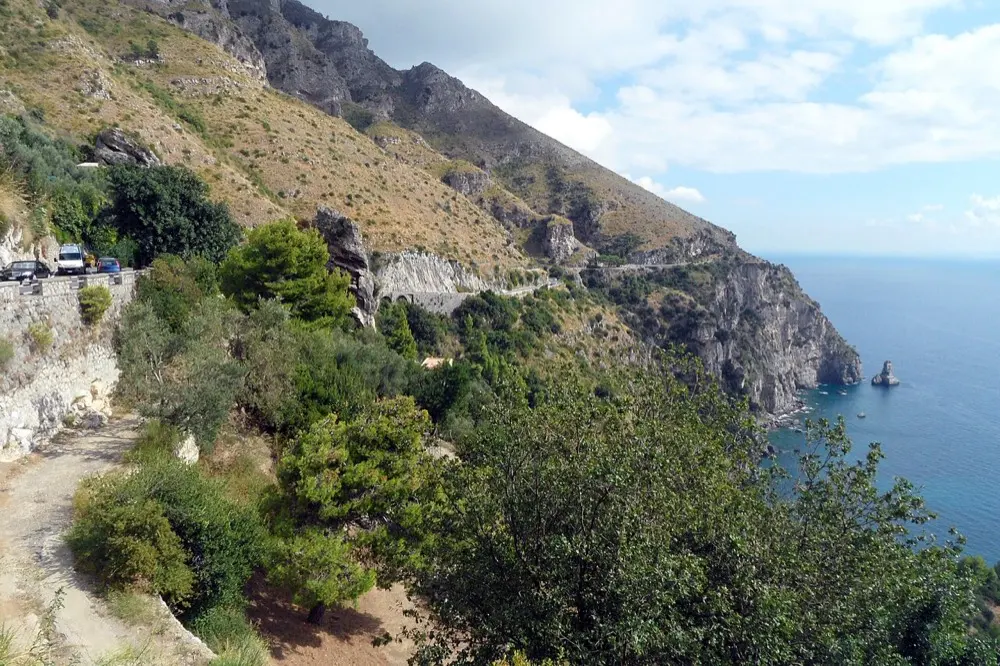
Two different problems on one trip
Most guides to this region treat Naples and the Amalfi Coast as one destination with one rule. They restrict in completely different ways, and preparing for the wrong one is how a trip goes wrong.
Naples restricts by zone: a dense patchwork of small schemes inside a few square kilometres, each with its own gates, its own timetable and its own exceptions. The coast restricts by capacity: the towns are tiny and vertical, the parking is finite, and in high season the state road connecting them admits only half the cars on any given day. What follows is what each place actually does, from the twenty-nine Campania zones we hold.
Naples is not one zone
The Centro Antico — Spaccanapoli, the decumani, via Duomo — is watched by four camera gates that do not share a timetable. Via Miroballo, via Duomo at piazza Museo Filangieri, and via Santa Sofia run 09:00–17:00 every day. The via del Sole gate runs to 22:00 Monday to Thursday and to 02:00 on Friday, Saturday, Sunday, holidays and their eves. One historic centre, two different answers to “is it open at nine in the evening?”, depending on which street you approach on.
Inside that perimeter sits another zone with its own rule. The university quarter below Federico II — via Mezzocannone and the streets around it — is restricted 09:00–22:00 Monday to Thursday and 09:00–02:00 from Friday to Sunday, later than the Centro Antico gates around it. It also does not admit mopeds or motorcycles unless they are separately authorised, where the Centro Antico gates do.
The third piece is Tarsia–Pignasecca–Dante: piazza Dante, the top of via Toledo, the Pignasecca market streets and Montesanto, restricted 09:00–18:00 daily at the piazza Gesù e Maria gate, with via Domenico Soriano guarding a pedestrian area at all hours and via Brombeis admitting residents only.
The pedestrian areas are the stricter thing
Three parts of Naples are not ZTLs at all but aree pedonali, and the distinction matters: there is no timetable to wait out and the exception list is much shorter.
- Via dei Tribunali, from via Duomo to via Atri and via Nilo, with piazza San Gaetano and via San Gregorio Armeno — the presepe street. Closed to traffic 24 hours, every day, behind a gate at via dei Tribunali/via Nilo since 8 December 2019. Deliveries only, 06:00–10:00, thirty minutes maximum.
- Borgo Marinari, the Castel dell’Ovo islet and its marina. Closed at all hours; permits go only to those living or trading on the islet.
- The Centro Direzionale walkways at the +12 m level, behind three gates since 1 October 2017, with an exception list that does not include residents.
If your hotel is on one of these streets, no ticket and no timetable helps — the answer is a garage outside and a walk in. Staying at a hotel inside a ZTL covers what a property can and cannot arrange.
Chiaia: an evening zone, and a Saturday one
Down in Chiaia the pattern changes again, and this is where two rules land on the same streets.
The Belledonne nightlife grid — vico Belledonne, via Alabardieri, via Bisignano, via Calabritto, via Cavallerizza, piazza dei Martiri and via Carlo Poerio as far as via Fiorelli — is restricted 19:00–07:00 every day. It is an overnight zone rather than a daytime one, so it bites precisely when you would drive down for dinner. Piazzetta Rodinò inside it is pedestrian at all hours.
Alongside it, via Morelli, via Santa Caterina a Chiaia, via Filangieri and via dei Mille carry two separate schemes over the same asphalt: a festive ZTL from 8 December to 6 January, on weekends, holidays and their eves, 10:00–14:00 and 16:00–20:00; and the year-round ZTL Chiaia, every Saturday, 10:00–13:30 and 16:00–22:00. Hotel and garage customers can be authorised, but a temporary permit takes four working days — which is a deadline, not a formality, and it is the reason to ask the property the week before rather than on arrival.
Marechiaro: a seasonal road, not a centre
The descent to Marechiaro on the Posillipo cliff is re-issued by ordinance every spring — in 2026, O.D. 725 of 30 April, running 16 May to 27 September. Below via Alfano the road is shut to all traffic around the clock for the whole period. Above it, the stretch is controlled 08:00–19:00, daily between 29 June and 13 September and at weekends and holidays either side of that. It is worth knowing because nothing about it looks like a historic centre: it is a scenic road to a fishing inlet, and it is gated.
The coast road rations cars by number plate — and the rule is inverted
Beyond Salerno the restriction stops being about centres at all. The SS163 Amalfitana, roughly forty kilometres from Vietri sul Mare to Positano through nine comuni, runs an alternate-plate scheme under ANAS ordinance 340/2019, between 10:00 and 18:00 on the days it is active. Outside those hours the road is open to everyone.
Here is the part to read twice, because most English-language write-ups state it backwards:
- On an even-numbered date, cars whose plate ends in an even digit may not circulate.
- On an odd-numbered date, cars whose plate ends in an odd digit may not circulate.
That is the opposite of the familiar Italian convention, where an even date admits even plates. The coast inverts it, and a visitor applying the usual rule will pick exactly the wrong day. The relevant digit is the last number in the plate.
The 2026 calendar ran it over the Easter and late-April bridges, then weekends and holidays through June and July, every day in August and September, and weekends and holidays again in October. Reported exemptions include residents of the coastal comuni, blue-badge holders with the holder aboard, taxis and NCC, emergency vehicles, and hotel guests on their arrival or departure day — that last one is worth confirming with your property in writing before you rely on it. The dates are re-set annually, so check the current ordinance rather than last year’s summary.
Salerno: the sensible way onto the coast
Salerno’s historic centre — the slice between via Roma and via Duomo — is restricted 24 hours a day behind fourteen automatic gates. Blue-badge holders may transit, stop and park freely; occasional access is notified through the Comune’s freephone line.
Salerno earns its place on this page for a different reason, though. It is where the coast road starts, it has parking and a railway station, and ferries run from it along the coast in season. For a visit to Amalfi or Positano in August, leaving the car in Salerno is not a compromise — it is the version of the day that does not involve a plate rule, a hairpin queue and a full car park at the other end.
Ravello: a window that is not an opening
Ravello sits above the coast and is permit-holders only, in six or more numbered zones plus lettered ones, under Ordinanza 26 of 9 August 2025. The 06:00–08:00 window quoted all over the internet is not an opening: it is an authorised thirty-minute parking allowance. Arriving at seven in the morning because a list said 06:00–08:00 is the local way to collect a fine.
Atrani and Maiori: two gates, and a band that runs to four in the morning
Atrani is the smallest comune in southern Italy and has two gates that do not work alike. The Via Gabriele di Benedetto gate has free bands — 10:00–12:00 and 16:00–19:00, Monday to Friday, not on holidays or their eves. The Via dei Dogi gate has none at all: it is active 24 hours, seven days. The scheme is set by Delibera di Giunta 24 of 26 February 2019.
Maiori restricts Corso Reginna between via Cristoforo Colombo and via Pedamentina, both directions, on a seasonal timetable under Delibera di Giunta 168 of 27 October 2021. From 1 April to 31 October it is restricted 09:00–15:00 and then 17:00 until 04:00. Winter is gentler — 09:30–14:30 from November to February, with an evening band added in March. The summer evening one is the trap: arrive for dinner and you are inside it, and it runs nearly to dawn.
Ischia: hours that carry a date
Ischia is the most frequently re-timed scheme on this site. Eight numbered gates cover the port, the Corso and Ischia Ponte, and the Comune re-issues their hours several times a year — tightened for the season, loosened when school returns, changed again in October. Under Ordinanza 164 of 14 September 2026: gates 1 and 2 on via Iasolino run 17:00–02:00 daily; gate 6 on Corso Vittoria Colonna runs 10:30–13:00 and 18:00–04:00; gates 7 and 8 at Ischia Ponte run 11:00–13:00 and 18:00–04:00. Any set of Ischia times you are given, including this one, needs a date attached to it.
One widely mangled point while you are here. The island’s seasonal divieto di sbarco is usually described as a ban on bringing a car to Ischia. It is not. Between April and October it bars vehicles belonging to Campania residents who do not live on the island, along with oversize vehicles. A hire car on a foreign or northern plate is not caught by it.
Caserta: the Reggia, and a summer evening scheme
Caserta is the day trip most people make from Naples by car, and its restriction is seasonal and mostly nocturnal. From 1 May to 30 September, Mazzini, Maielli and Largo Sant’Elena are closed around the clock, while Corso Trieste, Sant’Antida, San Carlo and Pollio run 10:00–13:00 and 18:00–22:30 Monday to Thursday, to 03:00 on Friday, and 10:00–03:00 at weekends and on holidays. Eight gates have been issuing fines since 2012. The Reggia’s own car parks are outside the scheme.
The towns we cannot tell you about yet
Campania is the third-largest region in our data and also one of the thinnest on hours: of its twenty-nine zones, fourteen still carry none.
Amalfi, Positano, Sorrento and Capri are not in our data at all, which is why this guide covers the coast through Salerno, Ravello, Atrani and Maiori and through the road that links them. Among the towns we do hold, Forio and Lacco Ameno on Ischia, Pozzuoli, Paestum, Agropoli, Castellabate and Cava de’ Tirreni are recorded as restricted with no hours yet sourced. Treat all of them the way you would treat any unnamed Italian centre: assume it is restricted, park outside, read the sign at the gate.
A plan that works
- In Naples, work out which of the eight zones your street belongs to; the centre has no single timetable.
- Remember that via del Sole, Mezzocannone and Belledonne all run late into the night.
- Treat via dei Tribunali, Borgo Marinari and the Centro Direzionale as closed at every hour.
- If a Chiaia property must authorise you, ask a week ahead — a temporary permit takes four working days.
- On the SS163 in season, check the date against your plate: even date, even plate stays off.
- For Amalfi or Positano in August, leave the car in Salerno and take the ferry.
- In Maiori, do not arrive by car for dinner between April and October.
- In Ravello, the 06:00–08:00 window is a parking allowance, not an opening.
Hours here are indicative and set by each Comune or, on the coast road, by ANAS — and several of these schemes are re-issued every single year. Confirm locally before you drive, and read the sign at the gate. If one has already caught you, ZTL fines explained covers what arrives and when, and the Campania region page lists every town we hold.
Check your destination before you drive.
Open the interactive ZTL mapMore driving guides
- Driving in Italy: the complete guide to ZTL zones
- ZTL fines in Italy: cost, how they reach you, and how to contest them
- How ZTL cameras work — and why rental cars always get caught
- ZTL signs in Italy: what they look like and what they mean
- Italy’s Euro 5 diesel ban from 1 October 2026: where it really applies
- How to avoid a ZTL fine: parking and route planning in Italy
- Renting a car in Italy: the complete guide (ZTL, tolls, fuel & permits)
- Italy’s driving zones explained: ZTL, Milan’s Area C & Area B, and LEZs
- Staying at a hotel inside a ZTL: how to reach it without a fine
- Driving in Rome & Florence: ZTL and parking survival guide
- Blue Badge and ZTL zones: driving in Italy
- Tuscany road trip: ZTLs, parking and routes
- Lake Garda by car: ZTLs on all three shores
- Puglia road trip: ZTLs from Bari to Lecce
- Sicily road trip: ZTLs from Palermo to Siracusa
- Driving in Milan: Area C, Area B and the streets no ticket opens