Lake Garda by car: ZTLs on all three shores
Most Italian road trips learn one region’s habits and apply them all week. Lake Garda is a single sheet of water divided between three regions and three provinces, and a lap of the shore crosses from one rulebook into another twice before you are back where you started.
One lake, three rulebooks
The western shore is Lombardy, in the province of Brescia. The eastern and southern shores are Veneto, in the province of Verona. The northern tip is Trentino. Nothing coordinates them, because nothing is supposed to: an Italian ZTL is written by the comune, and Garda has dozens of comuni around it.
The practical consequence is that Garda punishes the instinct that works elsewhere in Italy. You cannot learn the rule once in the morning and reuse it in the afternoon. What follows is what we can source for each town, and — just as important — which towns we cannot yet source at all.
Sirmione: one gate, and a closure that catches hotel guests
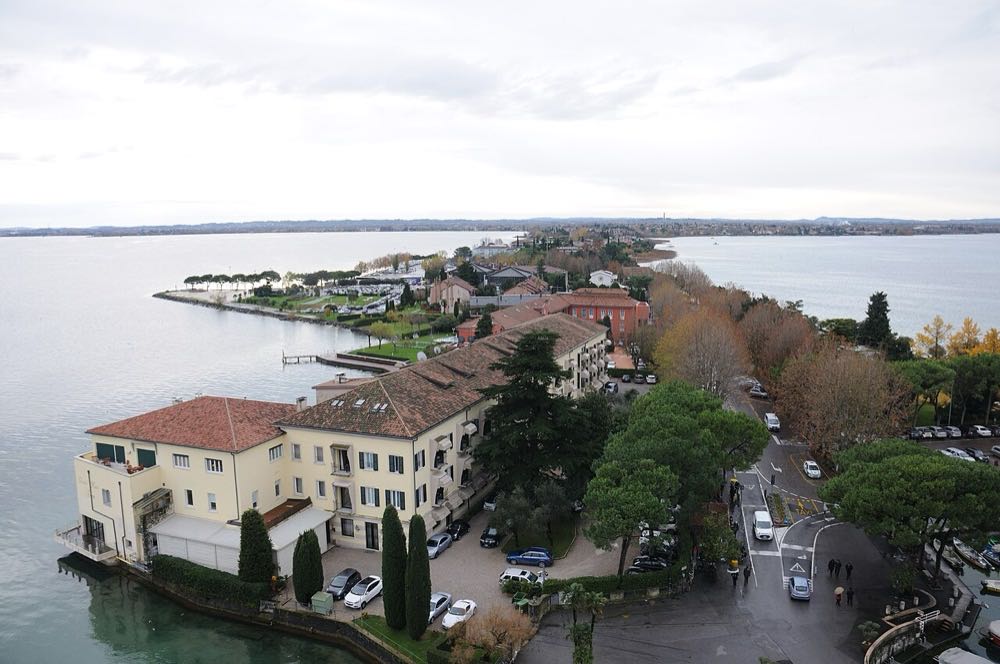
Sirmione’s old town sits at the end of a long peninsula and is entered over the castle drawbridge. There is one gate for the whole borgo, which makes it the simplest zone on the lake to understand and the hardest to talk your way around: there is no second route in.
The summer regime runs 23 March to 13 October 2026 under Ordinanza 30/2026, and admits residents and hotel guests only. The clause that catches people is the other one — on summer Sundays and holidays the borgo is closed to everyone between 14:00 and 19:00. Being booked into a hotel inside the walls does not lift that closure. If you are arriving on a Sunday afternoon in August, you are parking on the mainland and walking in, whatever your booking says.
Torri del Benaco: 24 hours, and the timed windows are not yours
Torri del Benaco keeps its lakeside old town behind five camera gates, restricted around the clock, permit holders only. Residents and businesses hold timed windows of their own, and those windows are published.
They are not openings for anybody else. This is the single most common way to misread an Italian ZTL, and it is worth carrying round the whole lake: when a comune publishes clock times, they usually attach to a permit category rather than to the public. A timetable is not automatically an invitation.
Bardolino: four gates, four timetables
Bardolino has no single opening hour, because each of its gates carries a different one. Between the season dates the gates run:
- Borgo Cavour, via Toscanini and piazza A. Moro — 18:00–06:00 on weekdays, 12:00–06:00 on Sundays and holidays.
- Lungolago Cipriani, at the via Mirabello junction — 12:00–06:00 every day.
- Lungolago Preite — 21:00–06:00 every day.
- Via D. Alighieri — 12:00–15:00 and 18:00–06:00 on weekdays, 12:00–06:00 on Sundays and holidays.
The season itself is re-set every year by ordinance and runs roughly from April to the start of November; Ordinanza 68 of 18 March 2025 ran it from 1 April to 2 November and carried the gate times above. Check the current year’s ordinance for this season’s dates. The restriction covers motorcycles and scooters as well as cars.
So “is Bardolino open?” has no answer without two more facts: which street you are approaching on, and what day it is.
Verona: the city at the foot of the lake
Verona is where most Garda trips begin or end, and it is the strictest thing on this page. Eleven camera gates guard the historic centre inside the bend of the Adige, between the Ponte Scaligero at Castelvecchio and Ponte Aleardi. It is restricted daily, around the clock, to permit holders. See the Verona ZTL map and hours for the gates.
One change matters more than the rest, because a great deal of published advice has not caught up with it. Ordinanza 1486 of 21 October 2024 abolished the free-access windows with effect from 28 October 2024. Guidance describing hours when anyone could drive into central Verona is describing a regime that no longer exists. The bookable slots that replaced those windows are open to residents of the province of Verona only, which is no help to a visitor.
Inside the zone, Piazza delle Erbe and the streets around it are a stricter pedestrian area rather than an ordinary ZTL, and Piazza Bra closed to private cars in May 2026.
The towns we cannot tell you about yet
Honesty is more useful here than coverage. Riva del Garda, Lazise and Valeggio sul Mincio are in our dataset, but we hold no timetable for them that we can trace to the comune, so this guide does not quote one. Peschiera del Garda, Desenzano del Garda, Salò, Malcesine and Limone sul Garda are not in the dataset at all, and several of them are known to restrict their centres.
We would rather print that than an invented timetable, because an invented timetable is the thing that gets a reader fined. Until each is sourced, use the working rule that holds everywhere on this lake: treat every historic centre as restricted until a sign at the gate tells you otherwise, and park outside it.
What the Euro 5 diesel rules do — and do not — do
The Po Valley regions agreed to ban Euro 5 diesel cars, and the date has moved twice: from 1 October 2025 to 1 October 2026 under Law 105/2025, and then, by Decree-Law 167/2026 of 28 September 2026, to 1 October 2027. Cars were due first, with vans and heavy vehicles in the years after.
The scope is narrower than most coverage suggests, and the narrowing is what matters for a Garda trip. The ban applies in the urban areas of comuni with more than 100,000 inhabitants — in Lombardy, Milan, Brescia, Monza and Bergamo; in Veneto, Venice, Padua, Verona and Vicenza. No town on the shore of Lake Garda comes anywhere near that threshold. The Euro 5 diesel ban does not reach Sirmione, Bardolino, Torri del Benaco or any other lakeside comune.
It was written to reach Verona and Brescia, the two cities a Garda trip is most likely to drive into — but it now reaches neither this winter. Piedmont cancelled it, Emilia-Romagna suspended it and Veneto postponed it, and on 28 September 2026 a national decree-law and a Lombard regional deliberation moved the date for every Po Valley region, Lombardy included, to 1 October 2027. Of everything on this page, this paragraph is the most likely to be out of date by the time you read it; confirm the current position before you rely on it. Our Euro 5 diesel guide sets out the position region by region, and the Milan guide covers Area B and Area C.
One thing does not change either way. An emissions ban is not a ZTL: a ZTL permit does not lift it, and parking outside a historic centre does not help when the restriction covers a whole urban area. Italy’s driving zones explained sets out how the two systems differ.
Driving the lake itself
The shore road is the reason to bring the car and the reason not to hurry. The western side runs through a long series of tunnels cut into the cliffs and is narrow where it is not underground; the eastern side is more open but busier in season. A full lap takes most of a day once stops are counted, and car ferries across the middle of the lake can save a substantial detour if you are crossing rather than circling.
None of that is where trips go wrong. They go wrong in the last two hundred metres, at the moment someone follows a sat-nav towards a hotel door inside a walled town. The car is for the road between the towns; each town ends at a car park.
A plan that works
- Look each town up on the ZTL map before you set off, and note a car park outside the zone for each one.
- Navigate to that car park, never to the accommodation. If you are staying inside a zone, read how to reach it without a fine first.
- In Sirmione, keep the Sunday and holiday closure from 14:00 to 19:00 in mind even if you are a hotel guest.
- In Torri del Benaco, treat the published resident windows as somebody else’s permission.
- In Bardolino, check the specific street you are approaching on rather than the town.
- In Verona, ignore any advice that still mentions free-access windows.
- For every other town on the lake, assume the centre is restricted and park outside.
Hours here are indicative and set by each Comune, which can change them without notice — and on this lake three different administrations can change them independently. Confirm locally before you drive, and read the sign at the gate. If one has already caught you, ZTL fines explained covers what arrives and when. The Veneto, Lombardy and Trentino-Alto Adige region pages list every covered town on their share of the shore.
Check your destination before you drive.
Open the interactive ZTL mapMore driving guides
- Driving in Italy: the complete guide to ZTL zones
- ZTL fines in Italy: cost, how they reach you, and how to contest them
- How ZTL cameras work — and why rental cars always get caught
- ZTL signs in Italy: what they look like and what they mean
- Italy’s Euro 5 diesel ban: postponed to 1 October 2027, and what still applies
- Does Google Maps avoid ZTLs in Italy? Waze and Apple too
- How to avoid a ZTL fine: parking and route planning in Italy
- Renting a car in Italy: the complete guide (ZTL, tolls, fuel & permits)
- Italy’s driving zones explained: ZTL, Milan’s Area C & Area B, and LEZs
- Staying at a hotel inside a ZTL: how to reach it without a fine
- Driving in Rome & Florence: ZTL and parking survival guide
- Blue Badge and ZTL zones: driving in Italy
- Tuscany road trip: ZTLs, parking and routes
- Puglia road trip: ZTLs from Bari to Lecce
- Sicily road trip: ZTLs from Palermo to Siracusa
- Driving in Milan: Area C, Area B and the streets no ticket opens
- Naples and the Amalfi Coast: ZTLs, plate days and where the car stops
- Speed cameras in Italy: autovelox, Tutor and how the fines reach you
- Italian motorway tolls and Telepass: how to pay without stress
- Where to park in Italy: line colours, parking discs and car parks
- Filling up in Italy: petrol stations, self-service and fuel names