ZTL signs in Italy: what they look like and what they mean
The sign at the gate is the only warning you get before the camera. Here is how to read every part of it: the red ring, the hours panel, the exemptions, and the electronic display that says whether the zone is closed right now.
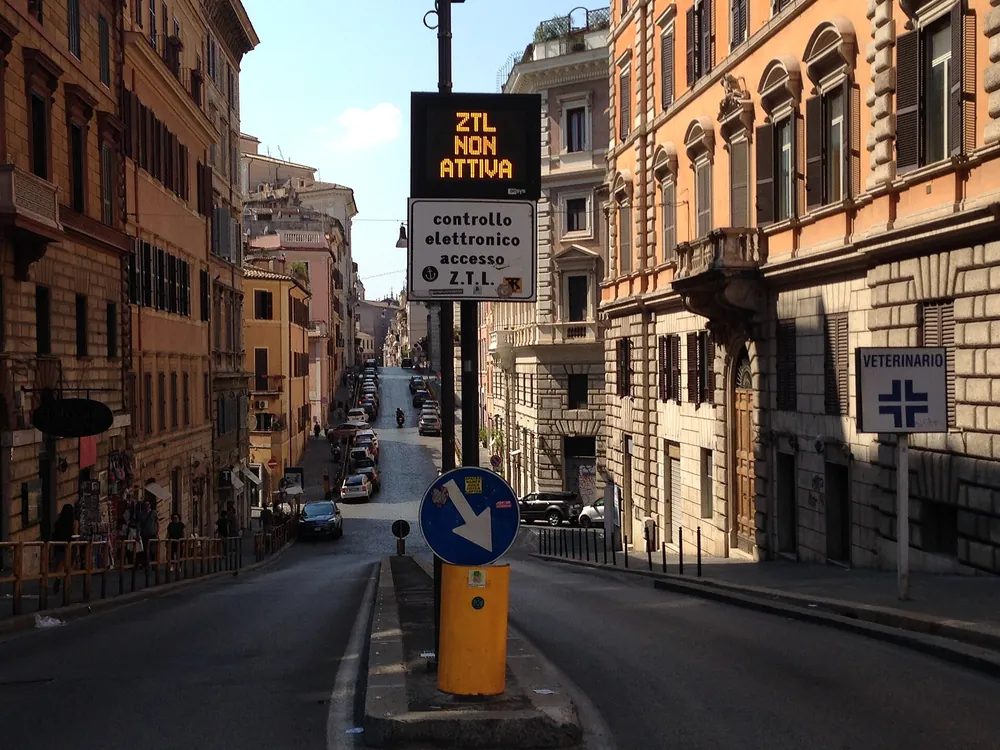
The sign at a glance
Every ZTL entrance is marked by the same sign, set out in article 135 of the regulations to the Italian Highway Code as figure II 322/a: a white panel reading zona traffico limitato above a white disc with a thick red border. The disc is the standard Italian “no vehicles” sign, and on its own it means exactly that. The words above it tell you the ban is a zone, not just this street.
In 2019 the Ministry of Infrastructure and Transport published guidelines setting out what should hang beneath that disc, and in what order. Their reference drawing for a camera-enforced zone with changing hours is below. Real gates are often older, shorter or more cluttered, but the parts are the same.
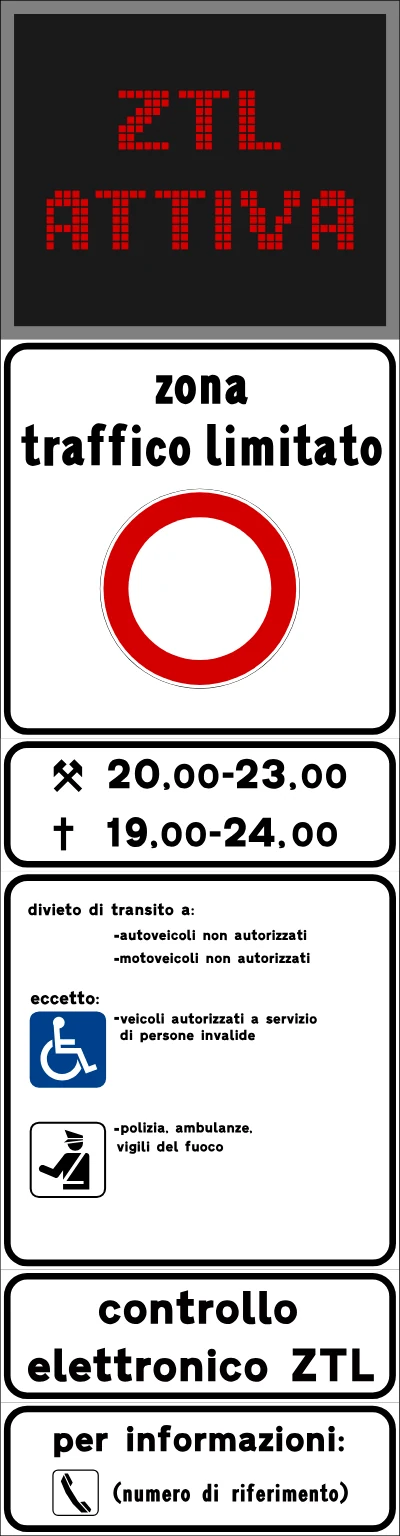
- The electronic display — says whether the zone is closed right now. Only some gates have one; more on that below.
- The ZTL sign itself — the zone starts here.
- The hours panel — when the ban applies. In the drawing, 20:00–23:00 on working days and 19:00–24:00 on Sundays and holidays.
- The bans and exceptions — who is banned (divieto di transito a) and who is let through anyway (eccetto).
- Controllo elettronico ZTL — electronic enforcement. There is a camera, and it does not need anyone to be watching.
- Per informazioni — a phone number, meant for people who may be allowed in, including disabled drivers and visitors who need to book access.
If you remember one thing, make it the red ring. Whatever else is on the pole, a white square with the words zona traffico limitato and a red-ringed disc means you are about to cross into a zone where your plate will be read.
The electronic display: “ZTL attiva” and “ZTL non attiva”
Where a zone’s hours change during the day and it is enforced by camera, the guidelines make an electronic display above the sign compulsory. It shows one of two messages:
- ZTL ATTIVA — the ban is in force. Do not drive in. The guidelines say this should be shown in red where the display can do colour.
- ZTL NON ATTIVA — the ban is not in force at this moment. Shown in green where the display allows.
Where foreign visitors are common, the same display should also show the message in English, either alongside the Italian or alternating with it: ZTL CLOSED for attiva and ZTL OPENED for non attiva. This is the source of the phrase that confuses so many drivers. ZTL closed does not mean the zone has been abolished or shut for works. It means the zone is closed to you: the cameras are enforcing and you will be fined if you enter.
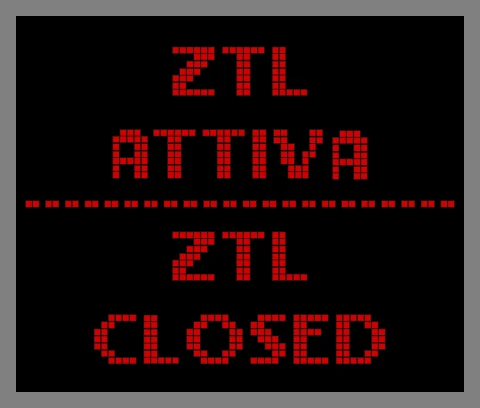
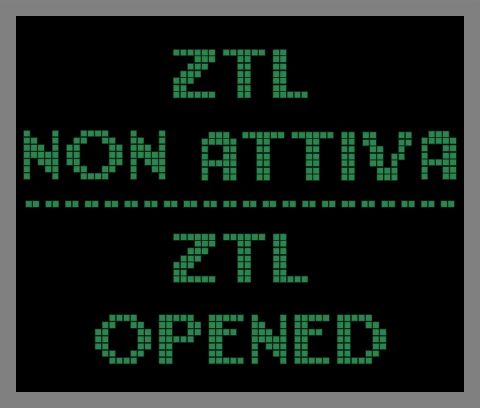
The word that matters is non. Attiva on its own is the dangerous one, and it is the shorter message, so it is easy to read the first half of ZTL non attiva as reassurance and the whole of ZTL attiva as the same thing at a glance.
“Varco attivo”: the older wording you will still see
Before 2019 there was no standard wording, and the most common message was VARCO ATTIVO (“gate active”) and VARCO NON ATTIVO (“gate not active”). Varco simply means the gate or opening in the zone’s boundary. The meaning is identical to the newer wording: varco attivo is closed to you, varco non attivo is open for now.
The guidelines apply to new zones and to existing ones when they are modified; for everything else they are a standard to work towards. So both wordings are on the streets today, sometimes in the same city.
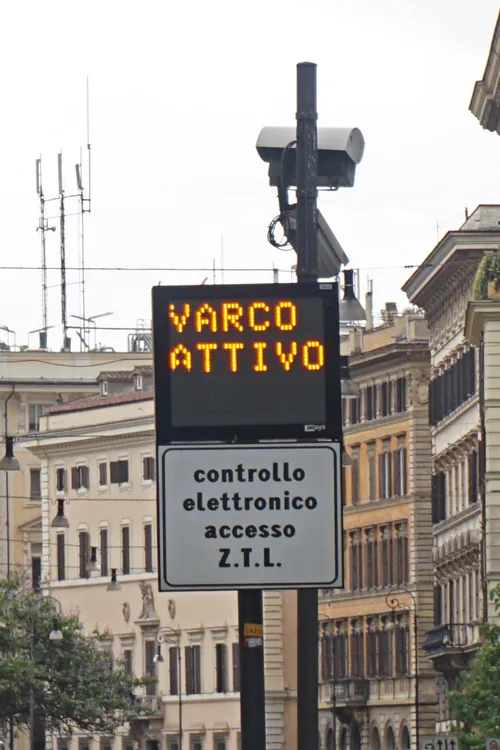
Notice the colour. The guidelines ask for red and green only “where the technology allows”, and many displays cannot do it. Rome’s gates, photographed in 2016 showing varco attivo and in 2020 showing ZTL non attiva, used the same amber lettering for both. A display that is not red is not telling you the zone is open. Read the words, not the colour.
“Open” means open now — not open until you leave
A display reading ZTL non attiva is accurate at the moment you pass it. It says nothing about ten minutes later, and the Ministry’s own guidelines flag this: a driver who enters just before the ban begins may be misled by the message, because a zone can switch on while you are still inside it.
That matters because entry gates are not the only cameras. The same guidelines allow a Comune to enforce a zone with changing hours inside its boundary and at its exits as well, precisely to catch cars that slip in just before the ban starts or leave just after it. On newer signs the panel reading controllo elettronico ZTL is worded to cover all of these cameras, not just the one at the gate, so do not assume the way out is unwatched.
Some displays solve the problem by adding the time, for example ZTL NON ATTIVA FINO ALLE 16:00 / ZTL OPENED UNTIL 16:00. Most do not have room. So when a gate says open, look at the hours panel beneath it before you drive in, and ask yourself when you will be driving out.
No display does not mean no enforcement
The display is compulsory only where a zone’s hours change and a camera enforces it. A zone that is closed around the clock has nothing to switch on and off, so its gate often has no display at all — just the fixed sign, the panels and the camera. The same is true of many smaller towns whose signs predate the guidelines.
This is the most expensive misreading of all: arriving at a gate, seeing no attiva message, and assuming the zone must be off. With no display, the fixed sign is the whole message. If there is no hours panel, or it reads 0–24, the zone never opens.
Reading the hours panel
The hours panel uses two symbols that most visitors have never seen:
- Two crossed hammers mean giorni feriali, working days. In Italian usage that is every day that is not a Sunday or a public holiday, so Saturday counts as a working day unless the panel says otherwise.
- A cross means giorni festivi: Sundays and public holidays.
Times are written on the 24-hour clock, often with a dot rather than a colon — 20.00–23.00. A range that runs past midnight, such as 22.00–06.00, is one continuous overnight ban. The guidelines list the ways a zone’s hours can vary: by time of day, by working day and holiday, by particular days of the week, and by months or seasons of the year. A panel can combine several of these, which is why the guidelines themselves warn Comuni against schedules too complex to read from a moving car.
If you cannot take in the whole panel before you reach the line, do not try to. Treat the zone as closed and turn away. You can look up the full timetable later — each city page on this site gives the hours we hold for it, and our ZTL map shows where the boundaries run.
Reading the exemptions panel
Below the hours comes the list of who is banned and who is not. On the model sign it reads divieto di transito a: autoveicoli non autorizzati, motoveicoli non autorizzati — no entry for unauthorised cars and unauthorised motorbikes — followed by eccetto, “except”, and a list of exemptions such as emergency vehicles.
Where the exemptions are too many to fit, the guidelines allow a single line instead: eccetto autorizzati ai sensi della Del. G.C. n.…, “except those authorised under council resolution number…”. Either way, “authorised” means your plate is on the Comune’s list before you cross. A hire car is not authorised by default, and nothing about being a visitor makes it so. The usual way on to the list is a hotel inside the zone registering your plate — see staying at a hotel inside a ZTL.
The blue disabled symbol on the panel deserves a warning of its own. It means vehicles serving disabled people are exempt, but the camera reads a plate, not a badge on the dashboard, and cities handle this very differently. Read Blue Badge and ZTL zones before relying on it.
The phone number under per informazioni is there for exactly these cases: the guidelines say it is for disabled drivers and for anyone the Comune is willing to let in, including non-residents who need to book.
The warning before the gate
Many zones are signposted one junction early. The guidelines model the advance warning on an ordinary junction sign, with the ZTL disc placed on the arrow that leads into the zone. That is your last chance to take a different turning, and it is far easier to act on than the gate itself.
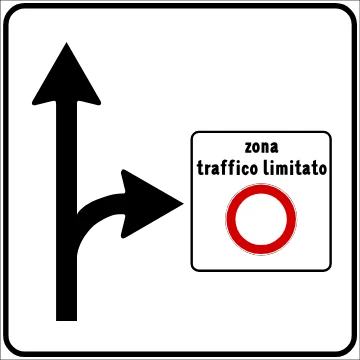
The guidelines also allow the ZTL symbol to be painted on the road surface at the gate. If you see the words or the red ring on the tarmac ahead of you, the gate is the line you are about to cross.
Leaving the zone, and pedestrian areas
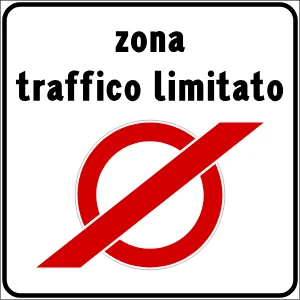
The same sign with a red diagonal bar through the disc marks the end of the zone. It is the sign you want to see on the way out.
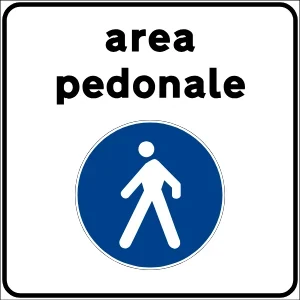
A blue disc with a walking figure and the words area pedonale marks a pedestrian area, which is stricter than a ZTL. There is usually no timetable to wait out: the street is closed to cars, full stop, apart from the few vehicles its own exemptions panel allows. For how pedestrian areas, charge zones and emissions zones differ from a ZTL, see Italy’s driving zones explained.
A glossary for the panel
The words you are most likely to meet at a gate, in the order you tend to meet them:
| On the sign | What it means for you |
|---|---|
| zona traffico limitato | Limited traffic zone. Cameras ahead. |
| ZTL attiva / ZTL closed | Ban in force now. Do not enter. |
| ZTL non attiva / ZTL opened | Ban not in force at this moment. Check when it starts. |
| varco attivo | Older wording for ZTL attiva. Do not enter. |
| varco non attivo | Older wording for ZTL non attiva. |
| giorni feriali (crossed hammers) | Working days, Monday to Saturday. |
| giorni festivi (cross) | Sundays and public holidays. |
| tutti i giorni | Every day. |
| divieto di transito | No entry for the vehicles listed. |
| autoveicoli / motoveicoli | Cars / motorbikes and scooters. |
| non autorizzati | Not on the Comune’s list — this includes your hire car. |
| eccetto | Except. |
| eccetto autorizzati | Except vehicles on the authorised list. |
| residenti | Residents. |
| carico e scarico | Loading and unloading — a window for deliveries, not for visitors. |
| controllo elettronico | Camera enforcement. |
| per informazioni | For information — the number to call. |
| fine zona traffico limitato | End of the zone. |
| area pedonale | Pedestrian area. No cars. |
What to do at the gate
- It says attiva, closed or varco attivo: do not cross the line. Turn off before it if you can.
- It says non attiva or opened: read the hours panel and work out whether the ban starts before you will be leaving. If it does, or you are not sure, stay out.
- There is no display: assume the zone is closed. That is what the fixed sign means.
- You have already crossed: do not turn round or reverse back through the gate. The camera has read the plate, and doubling back undoes nothing. Leave by the most direct route, and take care not to stray into a second zone — how ZTL cameras work explains why.
The sign is the legal notice, and the one thing this site cannot replace. Check the zone before you set off on the ZTL map, plan to park outside it, and if a fine arrives anyway, here is what happens next.
Sources
Sign shapes and the start and end signs: article 135 of the regulations to the Italian Highway Code (DPR 495/1992), figures II 322/a and II 322/b. Display wording, colours, English messages, panel order, advance warnings and internal and exit enforcement: Ministry of Infrastructure and Transport, Linee Guida sulla regolamentazione della circolazione stradale e segnaletica nelle zone a traffico limitato, prot. 5050, 28 June 2019. The sign drawings reproduce the Ministry’s own tables.
Check your destination before you drive.
Open the interactive ZTL mapMore driving guides
- Driving in Italy: the complete guide to ZTL zones
- ZTL fines in Italy: cost, how they reach you, and how to contest them
- How ZTL cameras work — and why rental cars always get caught
- Italy’s Euro 5 diesel ban from 1 October 2026: where it really applies
- How to avoid a ZTL fine: parking and route planning in Italy
- Renting a car in Italy: the complete guide (ZTL, tolls, fuel & permits)
- Italy’s driving zones explained: ZTL, Milan’s Area C & Area B, and LEZs
- Staying at a hotel inside a ZTL: how to reach it without a fine
- Driving in Rome & Florence: ZTL and parking survival guide
- Blue Badge and ZTL zones: driving in Italy
- Tuscany road trip: ZTLs, parking and routes
- Lake Garda by car: ZTLs on all three shores
- Puglia road trip: ZTLs from Bari to Lecce
- Sicily road trip: ZTLs from Palermo to Siracusa
- Driving in Milan: Area C, Area B and the streets no ticket opens
- Naples and the Amalfi Coast: ZTLs, plate days and where the car stops