Driving in Milan: Area C, Area B and the streets no ticket opens
In most Italian cities the question is a timetable: which hour the gate opens, which day it does not. Milan asks something else first. Here the charge over the centre, the emissions ban over almost the whole city and the handful of streets that admit nobody are three separate schemes with three sets of cameras, and the one that catches visitors most often is decided before the trip starts — at the rental desk, by the car you are given.
Three schemes, and they do not overlap tidily
Milan runs a congestion charge over its historic core, an emissions ban over most of the municipality, and conventional ZTLs and pedestrian areas inside both. A single drive can fall foul of all three, and each fails in a different way: one wants a payment, one wants a cleaner car, and the third wants you not to be there at all.
The Milan city page sets out each scheme in detail. What follows is the trip — the order to make the decisions in, and the places where the three schemes contradict the habits you brought with you from everywhere else in Italy.
Start with the car, not the map
Area B is a ban by emissions class, and no payment lifts it. It covers close to three-quarters of the municipality behind roughly 190 camera gates — not a historic centre, a city — and it runs Monday to Friday, 07:30 to 19:30. Petrol cars must be Euro 4 or newer, diesels Euro 6. Foreign plates are treated exactly like Italian ones, and a car that qualifies needs no registration.
So the first question is not where you are going but what you are driving, and the moment to ask it is at the rental desk. Ask for the car’s fuel type and Euro class and write it down. You will need the same answer again in Rome, across the north, and — from this autumn — in three more Lombard cities. A ZTL permit is no help here; an emissions ban is a different kind of rule, as Italy’s driving zones explained sets out.
The weekend is where the two schemes part company
Until recently the answer was that Milan restricted on weekdays. That is no longer true, and the split is the single most out-of-date thing in most published advice.
Area C now charges every day, 07:30 to 19:30, weekends included, since 1 January 2026, with national holidays excepted. Area B still runs Monday to Friday only. So a Saturday drive into the centre is chargeable but not filtered by emissions class, while a Tuesday drive is both. A holiday is exempt from the charge — which means the charge is not levied, not that the streets are open, because the ZTLs and pedestrian areas underneath are unaffected either way.
One more detail catches people who think of the gate as the offence. Area C bans movement inside the zone as well as the crossing, so a car parked inside overnight and driven out at nine in the morning has been circulating in Area C.
Buying an Area C ticket is not the same as paying
The ticket carries a PIN that has to be tied to your plate before it counts, and the window is precise: activate it on the day you drove in, or by midnight of the day after. Activating earlier does not cover the entry, so a ticket bought and activated the evening before your trip leaves that day unpaid. Garage-issued discounted tickets must be activated by midnight of the same day; a higher-priced late ticket can be activated up to seven days afterwards, but only through a MyAreaC account, and those open only with an Italian digital identity. As a visitor, treat the day-after deadline as the real one.
The streets no ticket opens
Underneath both schemes sit ordinary ZTLs and pedestrian areas, and these are the ones a visitor actually walks into.
The Quadrilatero della Moda has been closed to access and movement 24 hours a day, every day, since 12 May 2025, with cameras issuing fines from that September — via Monte Napoleone, via della Spiga, via Sant’Andrea, via Verri, via Borgospesso, via Santo Spirito, via Gesù and their neighbours. There is no ticket and no visitor permit. If a hotel sits inside it, guests may be set down at the dedicated bays for as long as luggage takes, and a booked space in a garage inside the zone works only because the garage files your plate that day. Ask the property what it actually does before you arrive with a car.
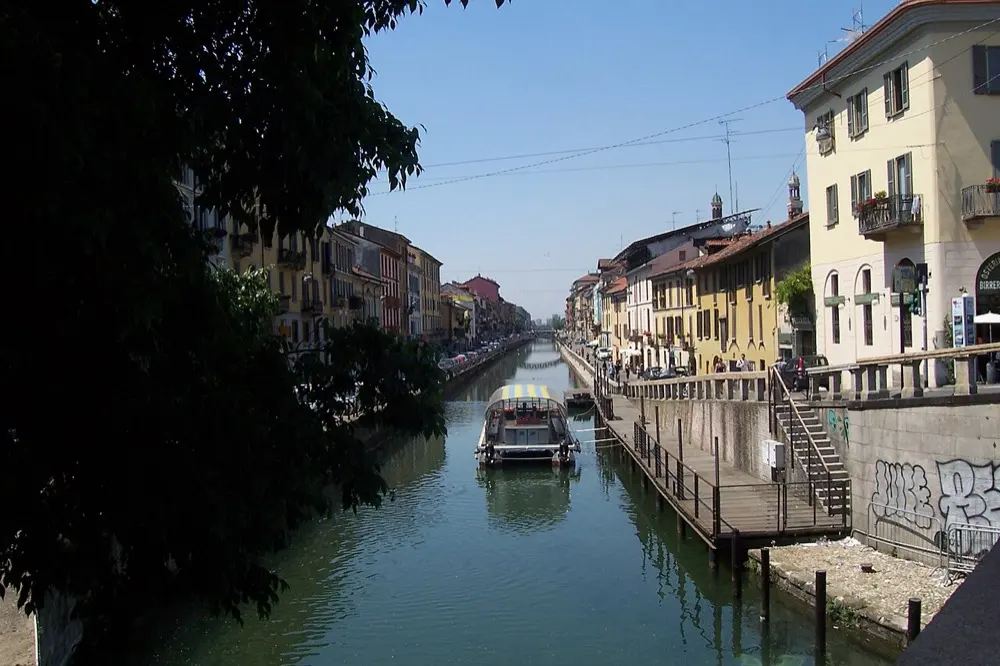
The Navigli are the other trap, and they bite exactly when you want to be there. Via Borsi, via Pichi, via Gola, via Argelati, via Fusetti, via Magolfa and via Paoli are night ZTLs every day from 20:00 to 07:00 under ordinanza 648/2015, and via Fumagalli is restricted around the clock. The canal banks themselves — the Alzaia Naviglio Grande, the Ripa di Porta Ticinese and the Alzaia Naviglio Pavese — are pedestrian areas, as are Piazza del Duomo, the core of Brera and the Colonne di San Lorenzo.
Park at a Metro terminus — but check which one
Milan is the one Italian city where leaving the car outside is genuinely easy, and the city publishes the list that makes it work: which interchange car parks sit outside Area B, and can therefore be reached at any hour by any car. Those are Bisceglie and Molino Dorino on the M1, Famagosta, Cascina Gobba, Cologno Nord and Gessate on the M2, and Comasina and San Donato on the M3.
The better-known ones are on the wrong side of that line. Lampugnano, Rogoredo, Forlanini, Maciachini and Bande Nere are inside Area B. No obstacle if your car is admitted — but if it is one of the barred classes, a park-and-ride inside the zone is not a way around the ban, it is the ban with a car park at the end of it. Advice that treats every terminus as a safe option is wrong about most of them.
1 October 2026: the rule that follows you out of the city
From 1 October 2026, Lombardy applies a Euro 5 diesel ban in the urban areas of its comuni over 100,000 inhabitants — Milan, Brescia, Monza and Bergamo — on the same weekday pattern, 07:30 to 19:30. Cars go first; vans follow on 1 October 2027 and the remaining categories in 2028. A mileage-based derogation, Move-In, exists for vehicles fitted with the regional telematic device, which in practice is not something a visitor can arrange at a rental desk.
For Milan itself this changes less than the headlines suggest, because Area B already required diesels to be Euro 6. The change bites on the day trips. A Euro 5 diesel that was merely barred from Milan is now barred from the urban areas of Bergamo, Brescia and Monza as well.
Two cautions, both of which may have moved by the time you read this. Lombardy is, as of late September 2026, the only Po Valley region still applying the measure on schedule — Piedmont, Veneto and Emilia-Romagna have suspended it or are substituting other measures — and the thresholds in Milan itself step up again on dates the city publishes years ahead, with Area C barring petrol Euro 4 from 1 October 2027 and Area B following in October 2028. Confirm the current position before relying on either.
Day trips: the rules change at the city limit
Almost every Milan trip leaves the city at some point, and each destination brings its own scheme rather than an extension of this one. Como is an emissions fascia town as well as a ZTL. Bergamo keeps its Città Alta behind restrictions that have nothing to do with Area B. Sirmione and the rest of Lake Garda are covered in the Garda guide, and the Euro 5 diesel ban does not reach the lakeside comuni at all — none is anywhere near the population threshold.
The habit that works for all of them is the one Milan teaches first: decide what the car is allowed to do before deciding where to point it.
A plan that works
- Ask the rental desk for the fuel type and Euro class, and write it down before you drive off.
- Check Area B first — it is the rule no payment lifts, and it covers most of the city.
- Remember the weekend split: Area C charges on Saturdays and Sundays, Area B does not run.
- If you buy an Area C ticket, activate the PIN against your plate by midnight of the following day.
- Treat the Quadrilatero and the Navigli lanes as closed — no ticket applies there.
- Park at a Metro terminus outside Area B: Bisceglie, Molino Dorino, Famagosta, Cascina Gobba, Cologno Nord, Gessate, Comasina or San Donato.
- Before a day trip in an older diesel, check the destination against the 1 October 2026 list.
Hours and thresholds here are indicative and change on published calendars as well as without notice — Area C moved to weekend charging on 1 January 2026 and the regional diesel rules move again this autumn. Confirm locally before you drive, and read the signs at the gate. If a fine has already arrived, ZTL fines explained covers how it reaches a foreign driver, and the Lombardy region page lists every town we hold.
Check your destination before you drive.
Open the interactive ZTL mapMore driving guides
- Driving in Italy: the complete guide to ZTL zones
- ZTL fines in Italy: cost, how they reach you, and how to contest them
- How ZTL cameras work — and why rental cars always get caught
- ZTL signs in Italy: what they look like and what they mean
- Italy’s Euro 5 diesel ban from 1 October 2026: where it really applies
- How to avoid a ZTL fine: parking and route planning in Italy
- Renting a car in Italy: the complete guide (ZTL, tolls, fuel & permits)
- Italy’s driving zones explained: ZTL, Milan’s Area C & Area B, and LEZs
- Staying at a hotel inside a ZTL: how to reach it without a fine
- Driving in Rome & Florence: ZTL and parking survival guide
- Blue Badge and ZTL zones: driving in Italy
- Tuscany road trip: ZTLs, parking and routes
- Lake Garda by car: ZTLs on all three shores
- Puglia road trip: ZTLs from Bari to Lecce
- Sicily road trip: ZTLs from Palermo to Siracusa
- Naples and the Amalfi Coast: ZTLs, plate days and where the car stops