Tuscany road trip: ZTLs, parking and routes
A Tuscany road trip is the case for hiring a car and the case against driving it into town, often on the same afternoon. The roads between the hill towns are the reason to come; the hill towns themselves are restricted almost without exception.
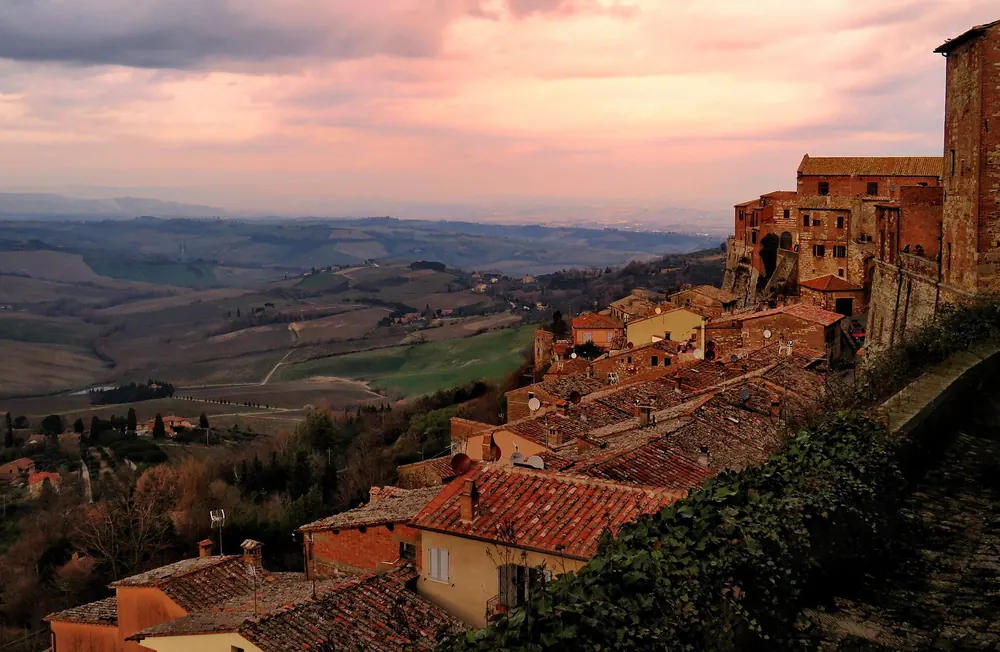
The thing that makes Tuscany simple
Almost every Tuscan town worth stopping in has a restricted historic centre, and almost every one of them has put parking within a few minutes’ walk of the gate. Once you accept the first half, the second half does the work: the car is for the space between towns, and each town ends at a car park.
That single decision — navigate to a car park, never to the accommodation — removes most of the risk from a Tuscany road trip. What follows is what each town actually restricts, because the differences between them are larger than visitors expect, and two of them are the opposite of what the landscape suggests.
Florence: the one to get right
Florence has the most tightly policed centre in Italy and fines visitors more often than anywhere else. The zone covers everything inside the ring of avenues that replaced the medieval walls — the Duomo, Piazza della Signoria, the Uffizi, Ponte Vecchio — and it is watched by roughly thirty-five enforcement points once permanent-ban and bus-lane cameras are counted alongside the timed gates.
The timetable is unusually generous by Italian standards, and worth knowing precisely: Monday to Friday 07:30–20:00, Saturday 07:30–16:00, and Sunday and public holidays free. A Sunday arrival in Florence is genuinely unrestricted at the daytime gates, which is the one useful piece of slack in the whole region.
The trap is the night zone. It runs Thursday to Saturday, 23:00–03:00, and it is not a July-and-August affair — it starts on the first Thursday of April and ends on the first Sunday of October. Read the word “summer” and skip it in April or late September and you will be fined. Florence has its own detailed guide alongside Rome.
Lucca: the walls are not the boundary
This is the most valuable thing in this guide, because it is the opposite of what everyone assumes. Lucca’s Renaissance walls form a complete four-kilometre circuit with gates cut through them, so the natural conclusion is that the wall is the camera line and every gate is a varco.
It is not. The centre inside the walls is graded into three tiers, and the outermost of them needs no permit at all and contains the public car parks. The camera line falls at ordinary street corners further in. Drivers who assume the wall is the boundary talk themselves out of a legal, signposted option and park much further away than they need to — and the inner tiers are the ones that are restricted around the clock, with the core streets stricter again between 10:30 and 14:00 and 18:00 and 21:00.
Siena: the cameras sit back from the gates
The same misreading, in a different shape. Siena’s restriction is effectively the whole walled city and runs continuously — daily, around the clock, not office hours. But the cameras are not mounted at the medieval gates. Several approach roads run inland from a gate to a camera set back inside the walls, and that stretch is exactly how you legally reach a car park.
So the ring of car parks below the walls is reachable, and the escalators and lifts up into the city are the entire point of the arrangement. If you are visiting anywhere near the Palio — early July or mid-August — plan differently: there are rolling closures for roughly a fortnight either side and a general driving ban on race day.
Pisa: the night zone stopped being seasonal
Pisa’s problem is that the thing everyone comes for is inside the zone. Piazza dei Miracoli — the Leaning Tower, the cathedral, the baptistery — sits within a historic-centre ZTL that covers both banks of the Arno and is enforced continuously. You cannot drive to the Tower.
The change worth knowing: the lungarni night zone along the river used to be a summer restriction and is not any more. Since the start of 2025 it runs Friday to Sunday, 22:00–05:00, all year. Advice written before that change understates it by eight months, by two hours a night, and misses Sunday entirely.
The smaller towns, and the two timetables that catch people
Arezzo runs two zones with genuinely different rules, and confusing them is the local way to collect a fine. Zone A is a split weekday restriction — 08:30–12:00, then 17:00–20:00 — with a long open afternoon in between. Zone B is active every day from 08:00 until midnight. Knowing you are in “the Arezzo ZTL” is not enough; you need to know which one.
Cortona reverses the usual seasonal logic, and runs two zones that do not share a timetable. In summer the red zone is continuous — 10:00 until four the following morning, with no afternoon break — while the yellow zone opens briefly between 15:00 and 16:00. In winter the yellow zone is light, late morning and early evening only, but the red stays continuous at 10:00–20:00. The busy season is when the town is hardest to drive into, which is the opposite of the assumption most people arrive with — and the midday gap you may have read about belongs to only one of the two zones.
Pistoia is straightforward — a continuous restriction over the centre around Piazza del Duomo — and is routinely skipped by people driving between Florence and Lucca, which is their loss and your advantage.
Montepulciano closes completely in summer
Montepulciano is the one to plan around, because its timetable inverts the usual assumption. From 1 May to 30 September the ZTL is active twenty-four hours a day — there is no daily opening at all. In April and October it runs 08:00–20:00, and from 1 November to 31 March, 08:00–17:00. The exits are camera-controlled as well as the entrances. So in exactly the months you are most likely to visit, the ridge is simply closed, and the car park below the walls is the only plan.
Volterra and Livorno, the two we used to have no hours for
Volterra runs a straightforward seasonal timetable: 10:00–20:00 from 21 March to 1 November, and 10:00–17:30 through the winter. Both versions cover the whole middle of the day, so the practical answer is unchanged — park outside the walls.
Livorno is a different animal: a working ferry port on a grid rather than a hill town, and most people driving in are catching a boat to Sardinia or Corsica. It runs seven lettered zones, generally Monday to Saturday 07:30–20:00 — but ZTL A covers the Venezia quarter from 20:00 to 05:00, every day of the year. That is precisely when you would wander over for dinner before a night sailing. The port itself is not the centre, and the terminal is reached without entering the restricted area.
The rule a ZTL permit does not solve
Everything above is about historic centres. Tuscany also has emissions rules that work on a completely different principle, and they are the ones most likely to catch a visitor in an older car, because they bind foreign plates and cover whole built-up areas rather than a centre. Parking outside the ZTL does not help; nor does a hotel registering your plate.
Florence operates the Scudo Verde, a separate and much larger scheme — around 38 km², roughly two-thirds of the urban area, monitored every day of the year around the clock. It has been issuing penalties since 1 July 2025, it restricts vehicles by emissions class, and its thresholds tighten annually, with a further step due in December 2026. It is not the historic-centre ZTL and does not change those hours; it is a second, wider net.
Beyond Florence, the region runs a winter regime. From 1 November to 31 March, when regional air-quality readings cross a set threshold, comuni in the affected areas — the Florence agglomeration and the Lucca plain among them — restrict diesel vehicles of Euro 4 and below, typically Monday to Friday between 08:30 and 18:30, under the regional air-quality plan. These are triggered by measurements rather than fixed dates, so they are announced locally and can appear at short notice.
If you are hiring, the fleet will be new enough that none of this touches you. If you are driving your own older diesel down from northern Europe, check before you travel. Our guide to Italy’s driving zones explains how emissions schemes differ from ZTLs.
The part you actually came for
Between the towns, none of this applies, and this is the part of a Tuscan road trip that no restriction touches. The Chianti road south from Florence, the Val d’Orcia below Montepulciano, the climb up to Volterra across empty crete — this is what the car is for, and it is genuinely difficult to reach any of it another way. The superstrada linking Florence, Pisa and Livorno is toll-free and fast when you simply need to cover ground; the A1 runs down the eastern side towards Arezzo and Rome.
Two practical notes. Distances in Tuscany are short but slow — sixty kilometres of ridge road is a comfortable ninety minutes, not forty — so an itinerary of two towns a day works and four does not. And approach roads to hill towns narrow steeply near the top; the car park at the bottom is almost always the right answer even where the gate is open.
A plan that works
Nothing here is difficult; it is all decided before you set off. A Tuscany road trip goes wrong at the point where someone drives towards a hotel door in a walled town, and right at the point where they drive towards a car park instead.
- Look each town up on the ZTL map before you set off, not at the junction, and note a car park outside the zone for each.
- Navigate to that car park, never to the hotel door. If you are staying inside a zone, see how to reach it without a fine.
- In Lucca, remember the outer tier inside the walls is open — you can park closer than you think.
- In Siena, follow the signed approach to a car park; the camera is set back from the gate, not at it.
- Treat Florence as free on Sundays and closed on Thursday to Saturday nights from April to October.
- Check Arezzo’s two timetables and Cortona’s season before either.
- In an older diesel, check the winter restrictions as well as the ZTL.
Hours here are indicative and set by each Comune, which can change them without notice. Confirm locally before you drive, and read the sign at the gate. If one has already caught you, ZTL fines explained covers what arrives and when. The Tuscany region page lists every covered town.
Check your destination before you drive.
Open the interactive ZTL mapMore driving guides
- Driving in Italy: the complete guide to ZTL zones
- ZTL fines in Italy: cost, how they reach you, and how to contest them
- How ZTL cameras work — and why rental cars always get caught
- ZTL signs in Italy: what they look like and what they mean
- Italy’s Euro 5 diesel ban: postponed to 1 October 2027, and what still applies
- Does Google Maps avoid ZTLs in Italy? Waze and Apple too
- How to avoid a ZTL fine: parking and route planning in Italy
- Renting a car in Italy: the complete guide (ZTL, tolls, fuel & permits)
- Italy’s driving zones explained: ZTL, Milan’s Area C & Area B, and LEZs
- Staying at a hotel inside a ZTL: how to reach it without a fine
- Driving in Rome & Florence: ZTL and parking survival guide
- Blue Badge and ZTL zones: driving in Italy
- Lake Garda by car: ZTLs on all three shores
- Puglia road trip: ZTLs from Bari to Lecce
- Sicily road trip: ZTLs from Palermo to Siracusa
- Driving in Milan: Area C, Area B and the streets no ticket opens
- Naples and the Amalfi Coast: ZTLs, plate days and where the car stops