Puglia road trip: ZTLs from Bari to Lecce
Most of this site is about timing: which hour a gate opens, which day it does not. Puglia is the region where that habit fails you. Its best-known old towns are shut around the clock, so the question is rarely when you may drive in — it is whether anyone may.
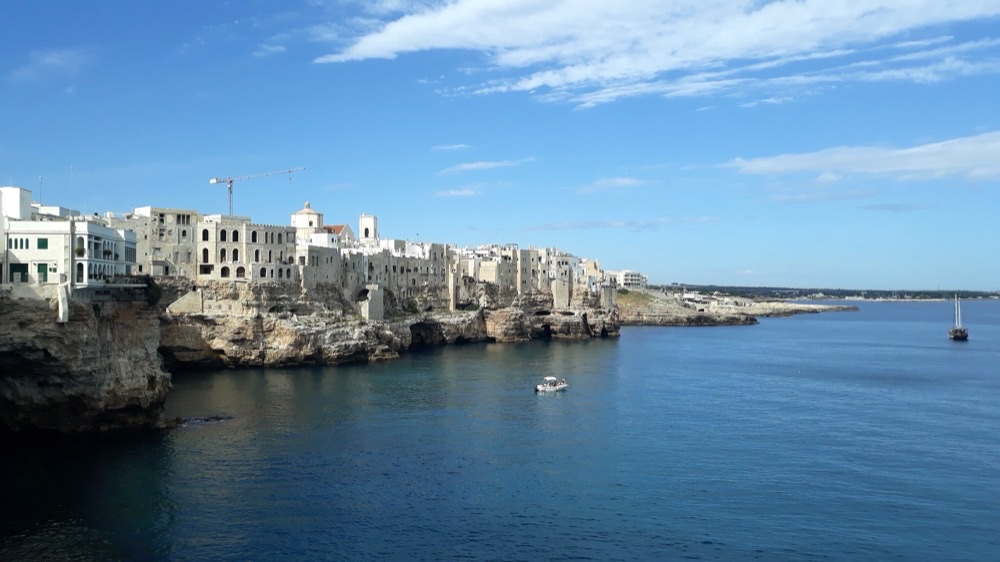
Why Puglia is not Tuscany
A Tuscan hill town usually restricts on a timetable, and a patient driver can wait one out. Puglia’s headline centres mostly do not work that way. Bari Vecchia, Ostuni and Polignano a Mare are closed round the clock, and no amount of waiting changes the answer.
That makes the region easier to plan for and less forgiving to improvise in. The car is for the long, fast roads between towns; every town ends at a car park outside its walls. What follows is what each place actually restricts, and — just as important in a region this thinly documented — which places we cannot yet tell you about.
Bari: an old town that admits nobody
Bari Vecchia is the strictest thing on this page. The old-town peninsula — Corso Vittorio Emanuele, Piazza Massari, Corso De Tullio and the Lungomare Imperatore Augusto, taking in San Nicola and the Cattedrale — is restricted to permit holders, 24 hours, every day, behind seven camera gates.
The unusual part is the exception list: there is not one. Bari issues no visitor permits of any kind. Most Italian comuni keep some route in for a hotel guest or a delivery; here there is none, which means the hotel trick that works in Florence or Bologna has nothing to attach to. Park outside and walk in — it is a small peninsula and everything on it is within a few minutes on foot.
Lecce: the ZTL that inverted, and the advice that has not caught up
Lecce reversed its scheme on 1 August 2025, under Ordinanze 1679 and 1689 of July 2025, and it is the most dangerous page in Puglia to be out of date about.
The centre used to close in the evening and stay open during the day. It now does close to the opposite. The gates are switched off for only two weekday windows — 10:00 to 13:00 and 16:30 to 20:00 — and the zone is restricted the rest of the time, early morning and mid-afternoon included. Sundays and holidays it is shut all day. The Porta Napoli gate is closed 24 hours, every day.
Read that against the advice still circulating and the trap is obvious. A guide describing the old regime will wave you in at eight in the morning or two in the afternoon, both now restricted, and warn you off six in the evening, which is now one of the two windows that are open. If a source tells you Lecce closes at night, it is describing a city that stopped existing in July 2025.
Ostuni: the windows are not openings
Ostuni’s white hilltop centre sits behind four camera gates, with further gates at the Pover’uomo bridge, Via Roma and Corso Mazzini. The zone is shut round the clock.
Times are published against individual gates — Via Francesco Cavallo and Via Francesco Vitale at 07:00–10:00 and 14:00–17:00, Via Montegrappa at 08:00–13:00 and 16:00–19:00 — and they are the single most misread piece of information in the region. They are the windows in which a gate will admit an already-authorised vehicle. They are not hours when the town is open. Arriving at nine because a list said 07:00–10:00 is how visitors are fined here.
The same caution travels well. Across Italy, a timetable published by a comune usually attaches to a permit category rather than to the public.
Polignano a Mare: stricter than a ZTL
Polignano’s old town, between the Arco Marchesale and Piazza Santa Maria delle Grazie, is recorded as a pedestrian area rather than a Limited Traffic Zone, behind a single camera gate at the Arco. The distinction matters: a pedestrian area is the stricter of the two. There is no timetable to wait out and the list of exceptions is much shorter, and it covers scooters and motorcycles as well as cars.
One honest caveat. This is one of the few records on the site we have not been able to confirm against the Comune, and whether the zone is formally an area pedonale urbana is unresolved. That uncertainty runs in the safe direction — treat the old town as closed, park above it and walk down — but we would rather flag it than imply a precision we do not have.
Otranto: the season sets the rule
Otranto restricts seasonally rather than permanently, and the Comune fixes the dates afresh each year. For 2026 the gates run from 15 June to 15 September, each on its own timetable: via Cappuccini from 20:00 to 06:00, and via San Francesco di Paola from 18:00 to 06:00. The Lungomare Terra d’Otranto is separately closed to vehicles.
Because the season is re-set annually, last year’s times are not a safe guide — an earlier ordinance ran the same two streets only to 05:00. Check the current notice before you rely on an hour.
Everywhere else: the rule that actually works
The five towns above are set out gate by gate because their rules are published and checkable. Across the region’s other thirty-seven zones the picture is patchier — and that changes what you should do, not how careful you need to be.
Assume every historic centre in Puglia is restricted, park outside the walls, and read the sign at the gate. That is not a hedge, it is the correct answer. Almost every Puglian centre that has been checked against its comune turns out to be a round-the-clock zone, so “assume closed” is right more often than any timetable you could look up — and it is the only rule that still holds when a town rewrites its ordinance in the spring, which Lecce did overnight.
You will find hours quoted elsewhere for Trani, Monopoli, Gallipoli, Taranto, Brindisi, Foggia and Barletta. Treat them as indicative. They circulate widely, but none of them traces back to a municipal source, and this guide prints a timetable only where an ordinance or a comune notice stands behind it. There is a reason for that discipline: when the 56 city records on this site were checked against primary sources, 35 carried errors, and they leaned overwhelmingly in the permissive direction — the kind that waves a driver through a gate that is shut. Lecce is the extreme case, where the widely-published hours did not merely lag, they described the opposite regime.
Alberobello is worth a line of its own, being the region’s busiest stop. The constraint in the trulli districts is parking rather than a camera: the streets around Rione Monti were built for nothing wider than a cart, and the practical move is the paid parking on the edge of town, then a short walk in. We hold no municipal source for its access rules, so take that as road sense rather than regulation — but arriving on foot is the right answer regardless of how the rules are written.
Driving the region
Puglia rewards the car more than most of Italy, because the distances between the places worth stopping are real and the public transport between them is thin. The peninsula is long: Bari to Lecce is a serious drive, and the Salento tip is further again. Budget more time between towns than the map suggests and fewer towns per day than ambition suggests.
Two habits do most of the work. Book accommodation with parking, or outside the walls — a masseria in the countryside sidesteps the problem entirely. And navigate to a car park rather than to a front door, because in Bari, Ostuni and Polignano the front door is behind a camera that does not care why you are there.
A plan that works
- Look each town up on the ZTL map before you set off, and note a car park outside the zone for each.
- Navigate to that car park, never to the accommodation. If you are staying inside a zone, read how to reach it without a fine — but note that in Bari there is no such route.
- In Lecce, distrust any advice that says the centre closes at night. It inverted in August 2025.
- In Ostuni, treat the published gate times as somebody else’s admission window, not an opening.
- In Otranto, check the current year’s season before trusting an hour.
- For every town not named above, assume the centre is restricted and park outside.
Hours here are indicative and set by each Comune, which can change them without notice — Lecce changed its entire regime overnight. Confirm locally before you drive, and read the sign at the gate. If one has already caught you, ZTL fines explained covers what arrives and when. Matera sits just over the Basilicata border and belongs on the same trip, and the Puglia region page lists every covered town.
Check your destination before you drive.
Open the interactive ZTL mapMore driving guides
- Driving in Italy: the complete guide to ZTL zones
- ZTL fines in Italy: cost, how they reach you, and how to contest them
- How ZTL cameras work — and why rental cars always get caught
- ZTL signs in Italy: what they look like and what they mean
- Italy’s Euro 5 diesel ban: postponed to 1 October 2027, and what still applies
- Does Google Maps avoid ZTLs in Italy? Waze and Apple too
- How to avoid a ZTL fine: parking and route planning in Italy
- Renting a car in Italy: the complete guide (ZTL, tolls, fuel & permits)
- Italy’s driving zones explained: ZTL, Milan’s Area C & Area B, and LEZs
- Staying at a hotel inside a ZTL: how to reach it without a fine
- Driving in Rome & Florence: ZTL and parking survival guide
- Blue Badge and ZTL zones: driving in Italy
- Tuscany road trip: ZTLs, parking and routes
- Lake Garda by car: ZTLs on all three shores
- Sicily road trip: ZTLs from Palermo to Siracusa
- Driving in Milan: Area C, Area B and the streets no ticket opens
- Naples and the Amalfi Coast: ZTLs, plate days and where the car stops
- Speed cameras in Italy: autovelox, Tutor and how the fines reach you
- Italian motorway tolls and Telepass: how to pay without stress
- Where to park in Italy: line colours, parking discs and car parks
- Filling up in Italy: petrol stations, self-service and fuel names